
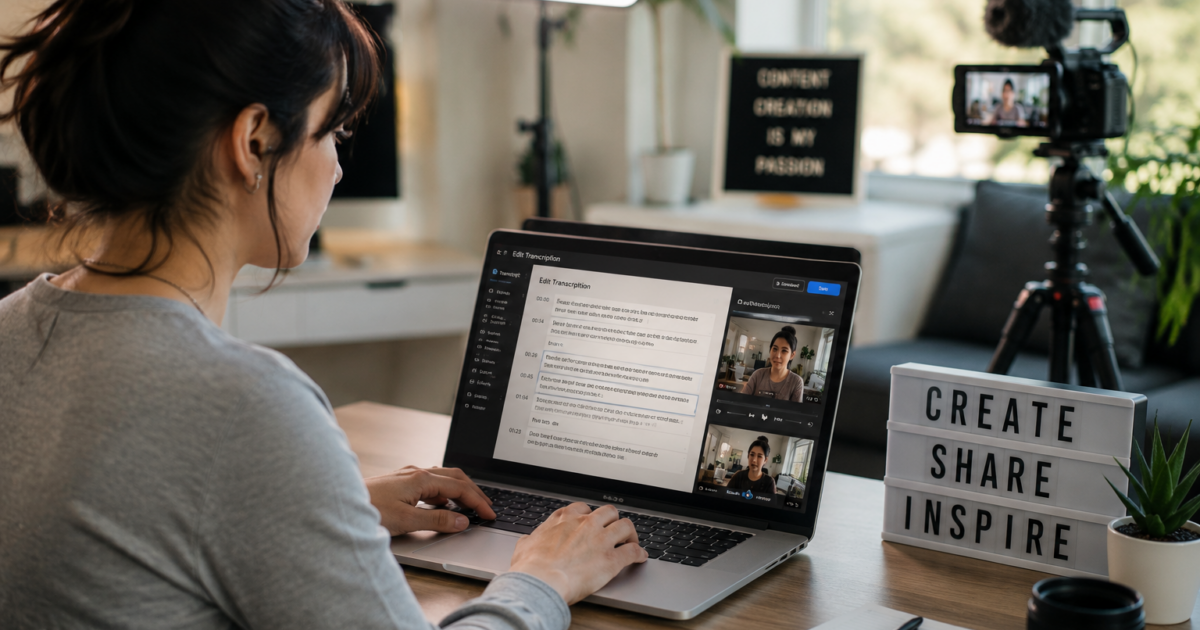
Automated transcription has moved from optional workflow tool to production infrastructure for content creators. The adoption numbers, engagement data, and cost comparisons now make a clear case: creators who skip transcription are leaving measurable audience reach, search visibility, and revenue on the table.
The statistics below cover six areas where the data is most concrete: how creators are using transcription, how much time it saves, what it does to revenue and discovery, which platforms are growing, how audiences respond to subtitles and localization, and what the cost math actually looks like. Every figure was checked against source pages in June 2026.
This roundup is built for mid-tier creators (10K to 500K followers) who are evaluating whether transcription tooling justifies the investment. The short answer from the data: it does, and the engagement and SEO numbers explain why.
Key Takeaways
- Nearly 70% of podcasters have switched to AI-driven transcription services, making it the default in professional podcast workflows.
- Videos with subtitles are watched 91% to completion versus 66% without, a 25-point gap that directly affects ad impressions and algorithmic favorability.
- Channels using transcripts for SEO see a 156% increase in organic discovery within 3 months.
- Content creators save an average of 15.3 hours per week by using automated transcript extraction versus manual methods.
- Only 43% of video creators are currently translating their content, meaning localized subtitles remain a competitive differentiator rather than a baseline expectation.
- Automated transcription reduces costs by up to 70% compared to manual methods, making back-catalog transcription financially viable for the first time for most independent creators.
- Videos with professional transcripts see 47% more engagement and 23% longer watch times than those using unedited auto-captions.
- The global AI transcription market is projected to grow from $4.5 billion in 2024 to $19.2 billion by 2034 at a 15.6% CAGR.
Transcription Usage Among Creators
1. Nearly 70% of podcasters have switched to AI-driven transcription services.
AI transcription has crossed the threshold from early-adopter tool to standard practice in podcast production. PodRewind’s 2026 analysis attributes the shift to speed, cost, and accuracy advantages over manual transcription. At this penetration level, platforms that do not offer transcription or easy integration with transcription tools are increasingly out of step with how professional podcasters actually work.
2. Only 43% of video creators are currently translating their content.
The majority of creators are leaving international audience engagement uncaptured. 3Play Media’s State of Captioning report, summarized by Kapwing, identifies budget and time as the primary barriers. For creators who do localize, this means the competitive field is still thin: translated subtitles remain a differentiator, not yet a baseline expectation.
3. Only 56% of brand websites with video have localized those videos at all.
Even among brands with dedicated video production budgets, nearly half are publishing in a single language. The Kapwing analysis of 3Play Media’s data puts this in sharp relief: localization is not yet a saturated practice, which means creators who add multilingual subtitles now are capturing ground their competitors have not yet claimed. For a deeper look at multilingual transcription statistics, the engagement and accuracy data by language pair is covered separately.
4. Among creators who do localize, 61% use subtitles while only 12% use dubbing.
Subtitles are the dominant localization method by a wide margin. The cost and workflow advantages of text-based localization over audio replacement explain the gap. 3Play Media’s research via Kapwing confirms that tools streamlining the transcript-to-subtitle pipeline capture the main segment of localization spend among creators who have already committed to international audiences.
Time and Efficiency Gains
5. An hour-long episode that used to take 3 to 4 hours of manual transcription now takes about 5 to 8 minutes with AI.
The production bottleneck that once forced creators to choose between transcribing and publishing has effectively disappeared. CleverType’s 2026 benchmarks put AI processing time at 5 to 8 minutes per hour of audio at 96 to 98% accuracy on clean recordings. The practical implication: a creator can move from recording to repurposing (blog posts, clips, social snippets) in the same working session.
6. Content creators save an average of 15.3 hours per week using automated transcript extraction versus manual methods.
At that scale, transcription is not a minor workflow optimization. VideoQuill’s 2025 analysis of YouTube channel workflows found this figure across creators using automated extraction compared to manual transcription. Fifteen hours per week is nearly two full workdays reclaimed for editing, content strategy, or additional uploads.
7. 62% of professionals using automated transcription save over four hours per week.
The time savings are consistent across professional contexts, not just creator-specific workflows. Sonix’s multilingual transcription data reports this figure alongside 25 to 30% improvements in meeting productivity among teams using automated transcription regularly. For creator teams with multiple people handling production, the compounding effect across roles is significant.
8. Voice dictation averages 150 words per minute versus 40 WPM for typing, a 3 to 4x speed advantage.
Script drafting, caption writing, and blog post creation from audio all benefit from this gap. CleverType’s 2026 voice-to-text guide cites this benchmark as the core efficiency argument for voice-first content creation workflows. For creators who script their videos or podcasts before recording, voice dictation turns transcription into a drafting engine that compresses ideation-to-script timelines by a factor of three or four.
9. Organizations using AI transcription see a 30% productivity increase on average.
The productivity gains extend beyond media-specific workflows. CleverType references ringly.io’s 2026 voice AI statistics for this figure. For content teams operating inside larger organizations (brand channels, corporate media, in-house production), this number reframes transcription tooling as a general productivity investment rather than a niche media expense, which matters when making the case to finance or procurement.
Revenue Impact and Monetization
10. Channels using transcripts for SEO see a 156% increase in organic discovery within 3 months.
Transcripts supply the long-tail keyword density that platforms and search engines index. VideoQuill’s analysis of YouTube channels using systematic transcript-based SEO found this figure across channels that embedded transcript text and used it to generate metadata. A back catalog of 100 episodes becomes a compounding search asset once transcripts are in place. For creators whose growth depends on discovery rather than paid promotion, this is one of the strongest ROI arguments for transcription investment. The automated transcription statistics page covers the SEO and discoverability data in more detail.
11. Localized videos see a 40% increase in engagement compared to non-localized versions.
Engagement lifts from localization compound with the completion rate advantage from subtitles. A 2026 study cited by Listen2It, reported by Kapwing, puts the engagement increase at 40% for localized versus non-localized content. For ad-supported or sponsorship-driven channels, a 40% engagement lift on international content directly expands the monetizable audience without requiring additional content production.
12. Videos with subtitles are watched 91% to completion, compared to 66% without.
Completion rate is the metric that drives platform algorithms, ad fill rates, and sponsorship CPMs. The 25-percentage-point gap documented in Sonix’s subtitle engagement research translates directly into ad impressions and algorithmic favorability. A creator publishing 10 videos per month with this completion advantage is effectively running a different monetization model than one publishing the same content without subtitles.
13. Videos with professional transcripts see 47% more engagement and 23% longer watch times than unedited auto-captions.
Not all transcripts deliver equal results. VideoQuill’s research found this gap between professional-quality transcripts and raw automated output left uncorrected. Publishing unedited auto-captions is not a neutral choice: it is a measurable underperformance relative to what higher-accuracy transcription produces. The quality of the transcript matters as much as its presence.
Platform Adoption Rates
14. The global AI transcription market will expand from $4.5 billion in 2024 to $19.2 billion by 2034.
The 15.6% compound annual growth rate documented by Market.us reflects demand across enterprise, healthcare, legal, and creator segments simultaneously. For context on how this growth maps to specific tool categories, the transcription software market trends page covers the segment-level breakdown. Creator-oriented tools are riding a broader wave of enterprise investment, not a niche trend.
15. North America held over 35.2% of the global AI transcription market in 2024, generating approximately $1.58 billion.
The United States alone contributed nearly $1.34 billion of that total, according to Market.us. North American creators operate in the most mature and competitive market for transcription tooling, which means the quality bar is higher and the tool options are more developed. The global CAGR points to significant growth in other regions as creator economies expand in Latin America, Southeast Asia, and Europe.
16. Medical transcription accounts for 34.7% of AI transcription usage; legal transcription holds 36% of business transcription applications.
Creator-focused transcription tools sit inside a broader ecosystem built on professional-grade requirements. Sonix’s multilingual statistics cite these figures to show where the largest adoption segments currently sit. The compliance and accuracy standards developed for healthcare and legal workflows set the quality floor that creator tools now compete against, which is why accuracy benchmarks from professional contexts are relevant to creators evaluating tools.
17. AI transcription platforms average approximately 61.92% accuracy under real-world conditions.
This figure from Market.us covers the full range of tools and audio conditions, including noisy environments, heavy accents, and overlapping speakers. It explains why accuracy benchmarks on clean audio (where leading tools reach 97 to 99%) matter: real-world performance varies significantly by tool and audio quality. For creators whose transcripts feed published content, SEO metadata, or subtitles, the gap between 62% and 99% is the difference between a usable first draft and a document that requires full rewriting. The AI transcription accuracy data page covers benchmark methodology in detail.
Audience Engagement Metrics
18. 80% of viewers are more likely to finish a video when subtitles are present, and subtitles increase average view time by 12%.
Watch time and completion rate are the two metrics that most directly affect platform ranking and monetization. Kapwing’s 2026 subtitle research documents both figures. The 12% view time increase compounds across a channel’s entire library: a creator with 500 videos, each gaining 12% more watch time from subtitle addition, is running a materially different channel than one without subtitles.
19. Viewers are 80% more likely to watch a video to completion in their native language.
For global audiences, transcription plus translation is a retention tool, not just an accessibility checkbox. A 2026 study cited by Listen2It and reported by Kapwing puts this figure at 80% for native-language viewing versus non-native. Creators publishing to multilingual audiences who skip translated subtitles are not just limiting reach: they are limiting how long the audience they do reach actually stays.
Cost and ROI Analysis
20. Automated transcription reduces costs by up to 70% compared to manual methods.
The economics of back-catalog transcription have fundamentally changed. Sonix’s cost comparison data puts the reduction at up to 70% versus manual transcription services. For creators who previously avoided transcription because of per-minute human rates, this shift makes transcribing entire archives financially viable and ROI-positive through SEO, accessibility, and content repurposing.
21. AI tools in podcasting can reduce production costs by up to 50% while cutting editing time in half.
Transcription is one component of a broader cost compression that AI tools are enabling across podcast production. PodRewind’s 2026 analysis cites this figure for AI-assisted production overall. For production companies or creators managing multiple shows, the combined savings enable higher episode volume without proportionate budget increases.
22. Rev’s human transcription service costs $1.99 per minute, which works out to $119.40 per hour.
For comparison, Sonix Premium runs $5 per audio hour. The cost difference is not marginal: teams processing 20 or more hours per month recover that gap in the first billing cycle. The Rev alternatives breakdown covers this cost comparison at multiple usage levels, including the per-seat and per-minute models used by other competitors.
23. AI transcription delivers 90 to 95% accuracy for clear audio and costs 70% less than manual services.
The accuracy-to-cost ratio is what makes automated transcription viable for production use rather than just draft generation. CleverType’s 2026 guide cites this combined benchmark. For creators whose audio quality is consistently clean (studio-recorded podcasts, scripted video, interview content with good microphones), the 90 to 95% accuracy floor means automated output requires light editing rather than full rewriting, which is where the time savings actually materialize.
What This Data Means for Creator Strategy
Subtitle quality matters more than subtitle presence. The 47% engagement gap between professional transcripts and raw auto-captions (VideoQuill, 2025) is a direct argument against publishing unedited automated output. The accuracy of the underlying transcript determines the quality of the subtitle, which determines the engagement outcome. Investing in a tool with a high accuracy baseline and an in-platform editor to correct errors before export closes this gap before it affects published content.
Back-catalog transcription is one of the highest-ROI applications of automated tools. Channels using transcripts for SEO see a 156% increase in organic discovery within 3 months (VideoQuill, 2025). If you have an existing library of audio or video content without transcripts, that library is largely invisible to search. Batch transcription of archived content converts a static archive into a compounding search traffic asset. At $5 per audio hour on automated platforms, the cost of transcribing 100 hours of back catalog is $500, a figure that most channels recover quickly through incremental search traffic.
The localization window is still open. Only 43% of video creators are currently translating their content (3Play Media, 2026). The engagement data is unambiguous: localized videos see 40% more engagement, and viewers are 80% more likely to complete a video in their native language. The window where translated subtitles are a differentiator rather than a baseline expectation has not yet closed. Creators who build multilingual subtitle workflows now are establishing audience relationships in markets their competitors have not yet entered.
Audit your current accuracy baseline before optimizing anything else. The industry average of 61.92% accuracy under real-world conditions (Market.us) is a useful benchmark for evaluating your current tool. If your transcripts regularly require heavy editing, the time cost of correction erases the efficiency gains that automated transcription is supposed to deliver. The right test is to run your specific audio type (your microphone, your recording environment, your speaking style) through any tool you are evaluating before committing to a platform.
Calculate cost per hour, not cost per month. Subscription models with monthly minute caps obscure the true cost of high-volume transcription. A team processing 40 hours per month at $5 per audio hour pays $200 in transcription costs. The same volume at $1.99 per minute for human transcription costs $4,776. The automated transcription statistics page breaks down cost comparisons across usage tiers and model types.
Time savings compound across the production stack. The 15.3 hours per week that VideoQuill documents (2025) is not just time saved on transcription itself. It is time freed for editing, strategy, additional content, or platform expansion. For creators operating at or near capacity, that reclaimed time is the input that enables the next stage of growth, whether that is more uploads, more platforms, or deeper production quality per piece.
FAQ
How accurate is AI transcription for content creators in 2026?
Accuracy varies significantly by tool and audio quality. Under real-world conditions across all tools and audio types, Market.us reports an industry average of approximately 61.92%. Leading platforms claim 97 to 99% accuracy on clean audio, meaning studio-recorded content with minimal background noise and clear speech. For creators whose audio quality is consistently high, the gap between average and top-tier tools is substantial. For content recorded in variable conditions (outdoor interviews, live events, multi-speaker panels), accuracy drops and the value of human review or correction workflows increases.
Does adding subtitles actually improve YouTube performance?
The data is consistent across multiple sources. Kapwing’s 2026 research found that 80% of viewers are more likely to finish a video with subtitles present, and that subtitles increase average view time by 12%. Sonix’s subtitle engagement data puts completion rates at 91% for subtitled videos versus 66% for those without. Both metrics (completion rate and watch time) feed directly into YouTube’s ranking algorithm and ad revenue calculations. The effect is not marginal.
What is the ROI of transcribing a back catalog?
VideoQuill’s 2025 analysis found that channels using transcripts for SEO see a 156% increase in organic discovery within 3 months. The cost of batch transcription on automated platforms is low enough (approximately $5 per audio hour on leading tools) that the SEO return typically justifies the investment within the first quarter. The exact ROI depends on channel size, content category, and how systematically the transcript text is used for metadata and descriptions, but the directional case is strong.
How much time does automated transcription actually save?
VideoQuill’s 2025 analysis of YouTube channel workflows found that content creators save an average of 15.3 hours per week using automated extraction versus manual methods. A separate figure from Sonix’s professional workflow data shows 62% of professionals save over four hours per week. The difference between these figures likely reflects the scope of transcription work: creators processing large volumes of audio see larger absolute savings than professionals transcribing occasional meetings.
Is it worth translating content if you have a primarily English-speaking audience?
The engagement data makes a case for translation even when the primary audience is English-speaking. A 2026 study cited by Listen2It via Kapwing found that viewers are 80% more likely to complete a video in their native language, and that localized videos see 40% more engagement overall. For creators whose content has any international reach, translated subtitles capture audience segments that are currently watching at lower completion rates or not watching at all. Only 43% of video creators are currently translating their content, so the competitive advantage of doing so is still meaningful.
What is the difference between auto-captions and professional transcripts for engagement?
VideoQuill’s 2025 analysis found that videos using professional transcripts see 47% more engagement and 23% longer watch times than those using unedited auto-captions. The gap comes from accuracy and formatting: higher-accuracy transcripts produce subtitles that are easier to read, correctly timed, and free of the errors that cause viewers to disengage. Publishing raw automated output without review is not equivalent to publishing professional transcripts, and the engagement data reflects that difference.